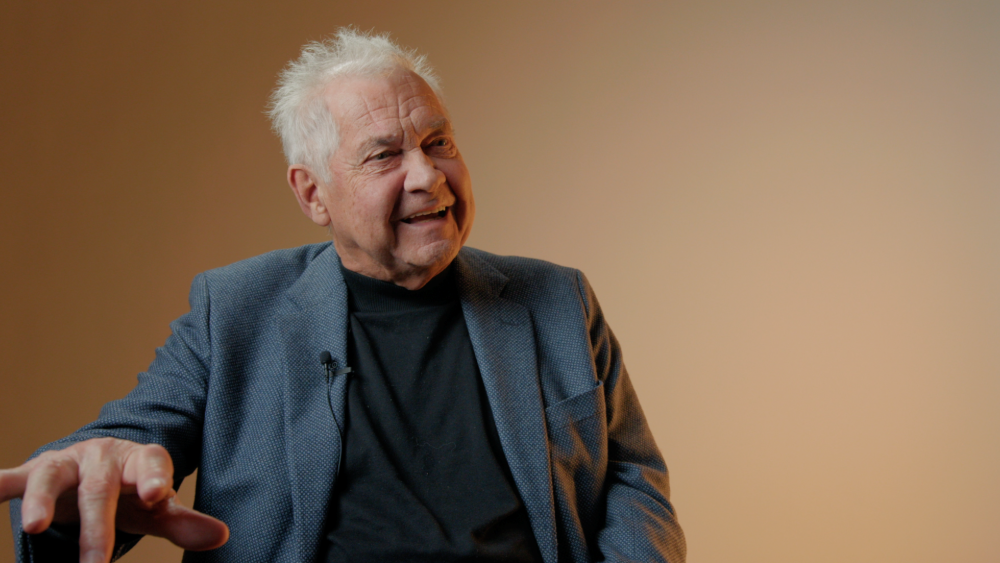
‘The challenge of creating a song which is catchy, but still manages to move people, is so exciting to me,’ Chris Eaton tells M. ‘I’m as enthusiastic about it now as I was when I started playing music as a kid.’
It’s a challenge that Chris is particularly skilled at, having written songs that have been subsequently recorded by the likes of Amy Grant, Janet Jackson and Sheena Easton. It’s his partnership with Sir Cliff Richard, though, that he is best known for. After composing Little Town — an arrangement of O Little Town of Bethlehem — for Sir Cliff in 1982, the pair united once again for 1990’s Saviour’s Day, which hit the top of the UK singles chart 35 years ago this month.
‘Cliff is, and always has been, an icon,’ Chris tells M. ‘We’ve developed a lovely, strong relationship in terms of our work and friendship. He’s been very loyal to me, and I still love writing for him. I know him very well now, like the kind of music he listens to and wants to record.’
Chris’ first exposure to music came through his regular attendance at church. The joint influence of his piano teacher and choirmaster collided with his love for the artistry of Billy Joel’s album The Stranger, the hooks of Hall & Oates and the glossy prog rock of Yes.
‘Yes were a wonderful way of experiencing landscaped music,' Chris says. 'I could always see the amazing scenes they created when I listened to them. The melodies and rhythms were so intricate, which appealed to both my musical side and the spiritual passions they explored.’
'Sir Cliff has been very loyal to me, and I still love writing for him.'
At the age of 16, Chris made a commitment to the church and his faith — a decision that has had a lasting impact on the direction of his music.
‘I wanted to write songs that have a positive message. That’s become a theme through all the music I’ve written ever since,’ he explains. ‘This decision helped me focus at a time when I could have gone in a million directions. But even though I wanted to pursue music, I was clueless as to whether it would become a professional thing.’
By his late teens, Chris was playing piano in coffee bars and churches with the likes of gospel artist Dave Pope. It was through this connection that Chris first encountered Sir Cliff, giving him the chance to showcase his songwriting to the veteran singer.
‘Sir Cliff was impressed by what he heard, and asked if I could make him a tape of five songs,’ Chris recalls. ‘I was really excited, so I put this together for him and sent it to his secretary, Gill Snow. After about 18 months, I was beginning to get frustrated — nothing had happened from this golden opportunity. I went to my church to pray and give this all to God. Two days later, Gill called to say that Cliff loved the tracks and was going to record four of them.’
Two songs from Chris’ tape — Lost in a Lonely World and Summer Rain — were included on Sir Cliff’s 1981 album Wired for Sound, which peaked at number four in the UK albums chart. It marked the beginning of what has become a fruitful and richly creative working relationship.
‘I went from working in insurance to being employed to write songs for Cliff Richard. That was it: I was working as a songwriter,’ Chris says with a laugh. ‘I very openly talk about this in terms of my faith. I felt it was all about trusting that things would work out if you put God first. That’s an intrinsic part of me and my music.’
After scoring a minor seasonal hit in 1982 with Little Town (‘It was very exciting — my first single release. I was 21 at the time and remember going to Woolworths to check how it was doing in the charts’), Chris harboured ambitions of writing music for Sir Cliff with more atmosphere and depth.
‘I adore cinematic songwriting, which pop sometimes doesn’t allow you to do,’ he explains. ‘Then there’s this higher level of pop that is singalong and catchy but has a sonic cathedral of music behind it. I really love this approach — I tend to think orchestrally in terms of a song’s bigger picture.’
Fuelling the writing of Saviour’s Day, Chris recalls: ‘I wanted the song to be about what Christmas means to all of us: people coming together, laying down their differences and coming home for the festivities. I touch on all of this in the verses and came up with something singable, but still with this atmosphere. I wrote the song really quickly; the original version was made in 90 minutes.'
Chris took a demo of Saviour’s Day to Sir Cliff’s publishers’ Christmas party. But, when he arrived, the singer’s secretary Gill informed him that Sir Cliff's next Christmas single had already been chosen.
‘Saviour’s Day was written in December 1989, so I was really excited about it when I got to that party,’ Chris remembers. ‘But despite being told that the next festive single had been chosen, I managed to play the song to Sir Cliff while sat in his Rolls-Royce in the car park. I put the tape on, pressed play and a minute went by. Sir Cliff then stopped the cassette and looked at me. I thought he didn’t like it, but he said: “This is a number one hit. I’m going to record it this year.”’
Shelving his initial pick, Saviour’s Day was indeed recorded by Sir Cliff and released in December 1990. Entering the charts at number six, it steadily climbed towards the top spot before dethroning, of all people, Vanilla Ice’s Ice Ice Baby to claim Christmas number one.
‘I was involved in a church celebration the night it went to the top spot and was playing Saviour’s Day live,’ Chris remembers. ‘I knew it was going to be number one, so I told everyone in the church that they could either hear it live now, or go to their cars and hear it being played on Radio 1 at the top of the charts. Everyone went mad.’
'Sir Cliff stopped the demo cassette and looked at me. I thought he didn’t like it, but he said: “This is a number one hit."'
Much like Sir Cliff’s 1988 Christmas hit Mistletoe and Wine, Saviour’s Day has endured thanks to its universal message of hope and love.
‘I still love the song. It’s so poignant, and I love how it’s almost become a part of Christmas folklore and tradition,’ Chris tells M. ‘It’s been covered by other artists, and people from different generations listen to it. Although I’m always motivated to write new material, I’m thankful for writing a song that has stood the test of time.’
Chris continues to seek out new musical experiences to this day, often collaborating with artists in his home studio. Much like his faith, his love of music has sustained him through the years.
‘The most important thing [for emerging songwriters] is to love what you do and be passionate about it,’ he advises. ‘Music is a gift: if you get earnings from it, then that’s a bonus.
‘I still have the love of putting my hands on the keys of a piano and allowing whatever I play to create a picture for me. I’m always looking for inspiration, such as hearing about the everyday details of people’s lives — some of that often gets filtered out into a song. Ultimately, writing a hit doesn’t necessarily mean you’re going to be rich overnight. It should all come down to loving the music that you write and perform.’